Winter constantly reminds us that it still has plenty of authority in New England. The recent snowfall blanketed streets, roofs, and vehicles across Medford, giving the city a look that residents of earlier centuries would have recognized immediately. Heavy snows have long shaped life in Massachusetts. Colonial records describe winters when roads vanished and travel halted for days at a time. Most famously, the Great Snow of 1717 brought repeat storms in March, resulting in snow drifts that reached second story windows in houses. While this week’s snow has been far less dramatic, it serves as a reminder that winter weather has always been part of the region’s story and it could stick with us as late as April (remember that April Fools Storm?).
We will hold our next public meeting on Monday, February 9, 2026 at 7:00 PM. Our agenda has been posted, and the meeting materials follow. We are meeting remotely via Zoom. Members of the public are welcome to attend, observe, and participate where appropriate.
Public Hearing – 36 Mystic Street:
Our evening will commence with a public hearing for 36 Mystic Street. The Commission will consider whether the building should be designated as preferably preserved.
The hearing will begin with a brief explanation of the demolition review process and the role of the Historical Commission in determining significance and preservation status. Commissioners will review the building’s previously established historical significance and discuss how it fits within the city’s demolition delay ordinance.
Following the presentation, the Commission will open the floor for comments. Commissioners will speak first, followed by members of the public who wish to provide input. Written comments may also be submitted before or during the hearing.
After the discussion concludes, the Commission will revisit its motion and vote on whether the building should be considered preferably preserved. The hearing will then conclude with a summary of the next steps.
Determination of Significance:
The Commission will continue its regular public meeting agenda. We will review two properties for a determination of significance.
17 Sharon Street:
The house at 17 Sharon Street in Medford, known historically as the Gooch Tenant House, was built between about 1872 and 1889 by local builder Joseph L. Gooch as part of the subdivision of the former Smith Estate in West Medford. The modest story-and-a-half end-house reflects late-19th-century residential development tied to the growth of railroad suburbs. Although later alterations such as vinyl siding and window changes have obscured some architectural details, the building retains its original form and setting within a dense historic neighborhood. Historically it functioned largely as a rental property, housing working-class tenants connected to local trades and industries.
85 Marshall Street:
The Edward W. and Ella L. Amory Wall House at 85 Marshall Street in Medford was built between 1886 and 1889 as a modest Italianate-style end house typical of late-19th-century suburban development. It was constructed for blacksmith Edward W. Wall, a Canadian immigrant, who lived there with his family and owned the property until 1947. Wall also developed additional nearby houses on the same parcel, helping shape the surrounding residential streetscape. The property sits on land historically connected to holdings of the Adams family, including John Quincy Adams, linking the site to earlier patterns of land ownership in the Hillside neighborhood.
Old Business and Project Updates:
The remainder of the meeting will include updates on several ongoing initiatives and preservation efforts across the city, including:
– Properties currently under demolition delay.
– Progress on our Annual Report.
– Update on the Brooks Estate Archaeological Survey.
-CPC Projects
– Work at Cross Street Cemetery
– Ongoing Historic Survey Work in Hastings Heights
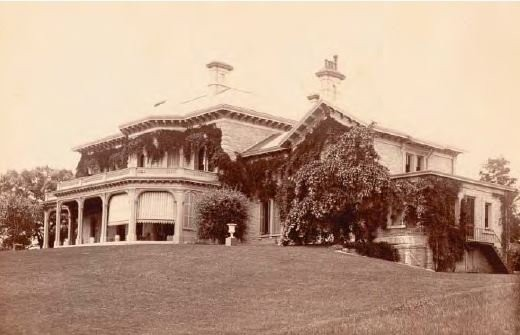
Point of Rocks in West Medford. Constructed in 1859, the house once stood in the Brooks Estate. It has since been demolished.
Residents are always encouraged to attend our meetings or submit comments for the record. Community participation is an important part of the demolition review process and helps ensure that Medford’s historic resources are fully considered.
 Medford Historical Commission