The Medford Historical Commission had a request to discuss the possible demolition to two buildings on South Street, numbers 23 and 31, to accommodate a new apartment building. The Commission discussed the process with the potential purchaser and provided the inventory forms prepared for the properties as part of the Medford Square South Neighborhood Survey project. These inventory forms provide an architectural description and historic narrative on which the Commission bases its review during the demolition delay review. The proposed building plans are included for the public to become familiar with the potential project.
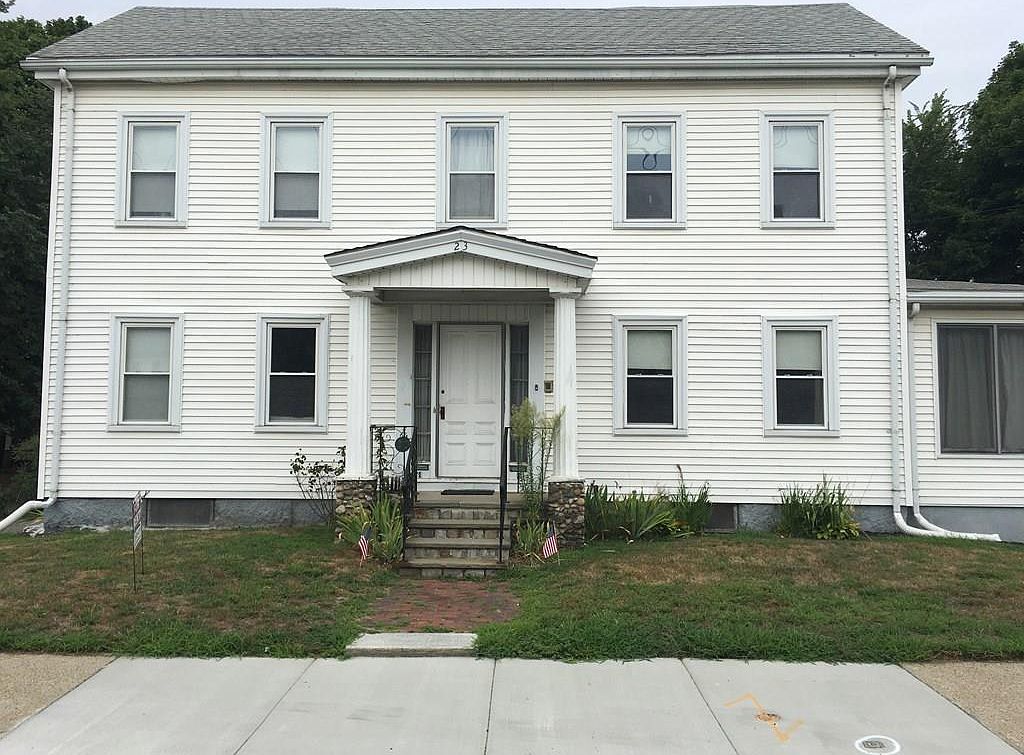
23 South Street – the Richardson – Hayes House. Although hidden behind vinyl siding, the building is a center entrance Greek Revival which matches others along the street.
The Medford Historical Commission has received an application for the total demolition of the building located at 75 South Street in the southern half of Medford Square (Medford Square South). The applicant plans to build a new three-family residence on the site. The building, which dates to the nineteenth century, is a contributing resource to the South Street streetscape. Entirely residential, the historic road was once the way to the ford on the Mystic from which Medford derives its name. The houses were once home to the shipyard owners, many of whom moved here after living near the Riverside Avenue yards. They were later home to some Medford notables. Several forms can be found on the Commonwealth’s MACRIS database. The Commission will determine significance at its December meeting.
75-77 South Street looking North toward Medford Square.
At our November Meeting, the Historical Commission found the house at 116 Dover Street to be not historically significant.
The building is a good example of an early 20th century residence whose style has been in use in New England for over 200 years. However, the building was unfortunately struck by lightning and was a total loss.
The Medford Historical Commission received the application for the demolition of the Cape Cod building located at 116 Dover Street in West Medford in October. Because the building is not a danger to the general public, the building required review by the Commission and followed normal procedure. A single family residence will replace the existing building.
116 Dover Street looking toward the front of the building. It is unusually oriented away from the street and has an attached garage at rear.
This month, the Commission voted to find the house at 120 Jerome Street historically significant.
The building is an early 20th century bungalow that maintains a fair amount of its original character. This particular neighborhood is part of the larger Smith Estate subdivision, which was developed in the late nineteenth century. Large houses on corner lots and main streets give way to smaller, modest, examples of residential architecture. This house is one of many middle class buildings erected on speculation and sold to first-time homeowners. The builder and occupant relate to the broader neighborhood, which you can read all about in the information below.
120 Jerome Street. The building fabric will be irreversibly altered resulting in loss of integrity and thus triggering the demolition delay
Click here for the neighborhood overview for West Medford from the Survey Plan.
Last month, the Medford Historical Commission received the application for partial demolition of 120 Jerome Street in West Medford. At our December public meeting we will determine whether or not this building is also preferably preserved.
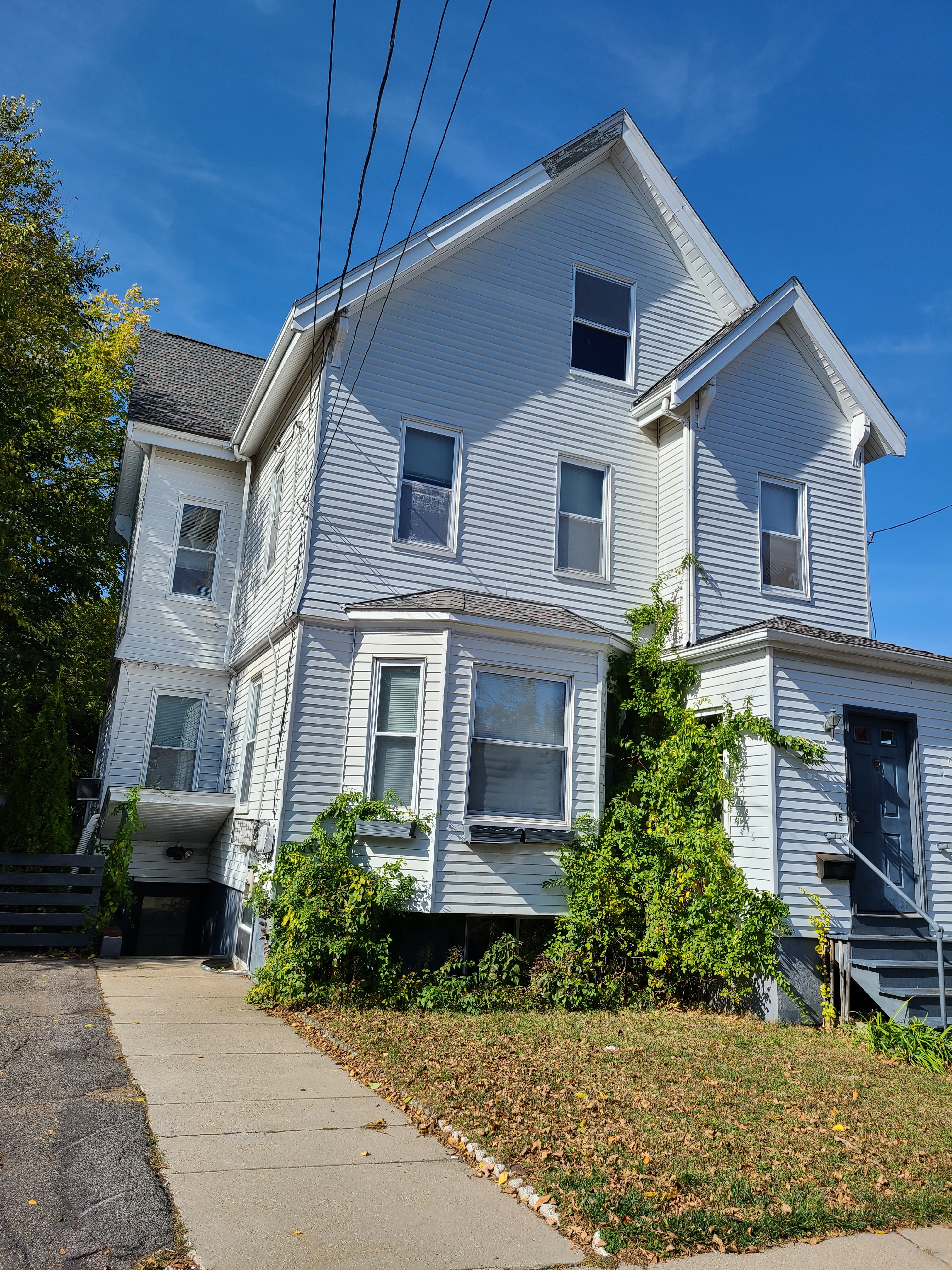
At our November meeting, the Medford Historical Commission has received an application for the demolition of a large Queen Anne Victorian located at 15 Hadley Place.
Located just off Salem Street, the building was constructed in 1896 on a small lane which has since become a vital traffic link when Interstate 93 was constructed in 1956. The building was set back when the road was widened and survived largely unaltered since.
15 Hadley Place as seen looking west from the street. The building is located halfway between Washington and Salem Streets.
At our October public meeting, we voted to find the Queen Anne home at 202 Middlesex Avenue “historically significant” based on the architectural descriptions and family research in the Form B, shared in our previous post.
Due to some scheduling irregularities, we will not vote on whether the property is also “preferably preserved” until our December meeting, on December 14.
We will be reviewing 3 applications for demolition – at 120 Jerome St, at 116 Dover St and 15 Hadley Place – and determining historical significance for a large Queen Anne home in the Wellington area, at 202 Middlesex Avenue.
If you follow us on Facebook, you’ll have seen my recent post about Elinor, a young woman who lived in Medford in the 1930s and kept a diary. That diary has been found by a young woman living in the Boston area NOW and she publishes Elinor’s entries on Instagram – along with photos and a little background research about the names and places mentioned in the diary.
WELL!!
It looks like Elinor may well have spent the summer of 1933 at 202 Middlesex Avenue! In that summer, Elinor lived with a family she calls “Uncle Roy” and “Aunt Shirley,” or “The Robbinses” and she describes many of their local outings and adventures, including an evening “running walk” around the Fellsway and Wellington Road. Furthermore, according to our surveyors’ Form B on 202 Middlesex Ave,
“Henry Lyman Cornell (1852-1935) was a music teacher and vocal musician of opera. Little could be ascertained about his career through readily available records, but several brief newspaper accounts suggest he was actively performing in Boston as a basso during the 1880s. In 1900 the household, identified as 202 Middlesex Avenue, included his wife, Harriet Sophia (Withington, 1849-1940), whom he married in 1874, three sons, and three daughters born between 1879 and 1899. In 1930[…] the household included his daughter, Shirley (b. 1880) and her husband Leroy H. Robbins (b. 1880), a real estate broker.”
Medford’s current Demo Review process is not likely to be a surprise or an exceptional burden for homeowners or developers.
Most Massachusetts communities, from Boston to Woburn and beyond have a demo review process similar to that in the City of Medford. A property owner would be hard pressed to “leave Medford” and buy a property nearby that does not need to follow this, or a similar process, before being demolished. Similarly, a developer – someone whose business it is to redevelop properties – would not likely buy in Medford, Arlington, Woburn, etc and not know that older buildings will be subject to a demo review process by the town or city.
The Historical Commission’s goal is NOT to fully restore houses to their historic state – we are not here to recreate Sturbridge Village or Plimoth Plantation in the heart of Medford. Nor are we, personally or professionally anti-development – the commission includes historians, archivists and homeowners, as well as architects, folks in real estate, and building preservationists. You can read our bios here.
US! off-duty at Salvatore’s
If we’re not planning to turn Medford into a history theme park, what are we up to?
NOT US! a photo of a Plimoth Plantation wedding, via Boston Globe
The Medford Historical Commission, like most Historical Commissions in towns and cities across Massachusetts, is part of city government. Our procedures were put in place to allow the community to bring their preservation concerns to our public meetings, with developers present. During these discussions, we increase public knowledge about the historic uses of our buildings, neighborhoods and residences, about the city’s past residents, and about the past design and construction of the buildings in our city. And, finally, for buildings deemed both “historically significant” AND “preferably preserved” – a multi-step, public process – we discourage demolition in favor of designs that preserve the historic character.
Monthly Meetings – Our meetings are the second Monday of the month, and they were traditionally held in Room 201 in City Hall; like most of Medford’s city boards and commissions, we’ve been holding Zoom meetings since May 2020. The public is always welcome to listen in or speak up!!
Agendas & Minutes – Our agendas are posted in City Hall, and in the Transcript, and we try to post them on Facebook and here on the website.
This is the third post in a series of Clarifications & Corrections. The first post in the series was “Pro-Active Preservation,” about our ongoing survey and inventory research. The second was “Kissing Cousins” and it explained the different roles of the Historical Commission, the Historical Society and the Historic District Commission.





 Medford Historical Commission