A Brush With History: Thomas Brooks Park Artifact Cleaning & Cataloging Day
Location: Medford Public Library at 111 High Street Date & Time: Monday, March 30, 2026, from 9AM – 5PM
Registration is Required: Email—HistoricalCommission@medford-ma.gov
Join the Medford Historical Commission and SWCA archaeologists for a hands on day experiencing the history uncovered at Thomas Brooks Park.
We’re looking for 8-10 volunteers to roll up their sleeves and help gently clean, sort, and catalogue artifacts. No experience necessary, just curiosity and an interest in Medford’s past. All volunteers will work alongside professional archaeologists.
This is a great opportunity to connect with one of our historic landscapes and to learn first hand how the Historical Commission preserves our community’s past.
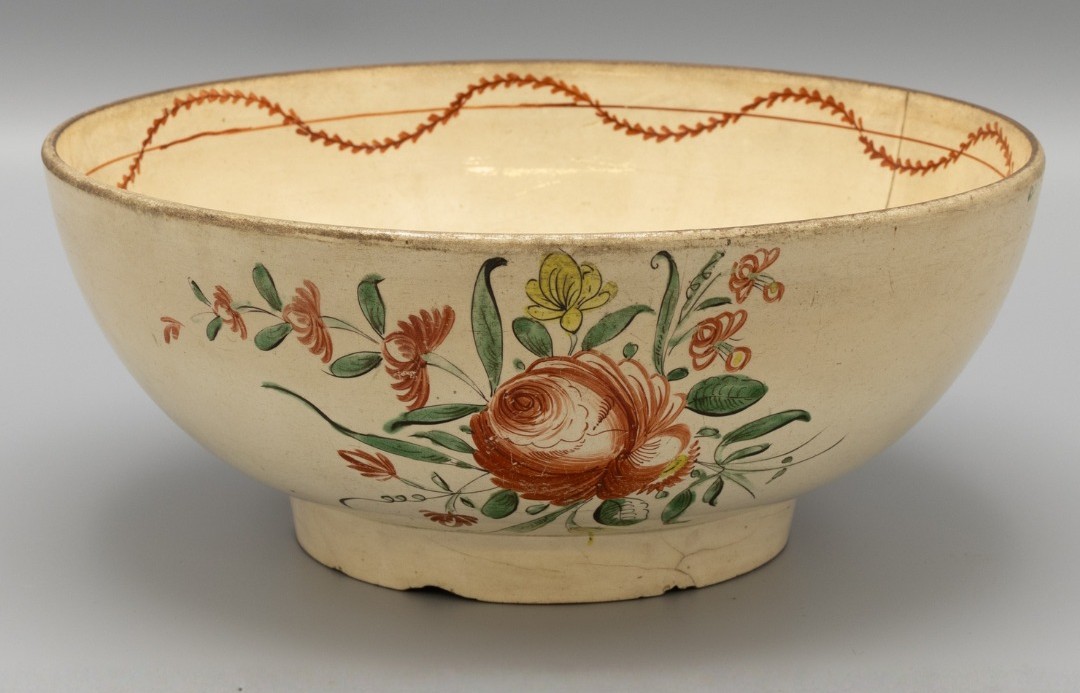
Volunteers will get to see fragments of a bowl featuring the “King’s Rose” decoration, as seen in this complete example from the collection of Old Sturbridge Village.
The Medford Historical Commission is looking for adventurous volunteers to help with the archaeological dig planned at Thomas Brooks Park!
Thomas Brooks Park is a landscape of deep cultural significance. It weaves together Medford’s local history, the legacy of slavery in New England, and the presence of Native American heritage—all preserved within this historic site. The current archaeological excavation is being conducted as part of due diligence in preparation for planned preservation and protection efforts. Please note that all unauthorized digging, metal detecting, or artifact collecting is strictly prohibited.
Unearth hidden stories from Medford’s past as you roll up your sleeves, dig into history, and help uncover artifacts that haven’t seen daylight in centuries. No experience is required – just curiosity, enthusiasm, and a readiness for discovery. Here are some of the early details:
🗓 When: The end of October or early November. We will post the specific days as we get closer. ⏰ Schedule: Volunteers will come for one full day, 8:00 AM–4:00 PM (includes a 30-minute lunch break). We can have up to 6 volunteers per day. 📋 Orientation: All volunteers must attend a 1-hour orientation on a date in advance of the dig.
Volunteers must be 18 or older to participate. If you can’t make it to the dig itself, we’ll post about lab work (cleaning and cataloging what is recovered).
☀️ Rain or shine, the dig goes on!
No need to bring equipment — just wear sturdy, closed-toed boots or shoes with ankle support. (Sorry, no flip-flops!) You may bring your own gardening gloves and knee pads if you’d like. Be sure to pack your own lunch and water for the day.
Ready to make history? 📧 Email the Medford Historical Commission at historicalcommission@medford-ma.gov with your name, availability, and best contact method to be added to the list.
There is an incredible opportunity to help the Medford Brooks Estate Land Trust (M-BELT). The non-profit organization seeks a new President. You could be the right candidate! If your resolution is to volunteer, consider doing so in support of one of our treasured historic landmarks.
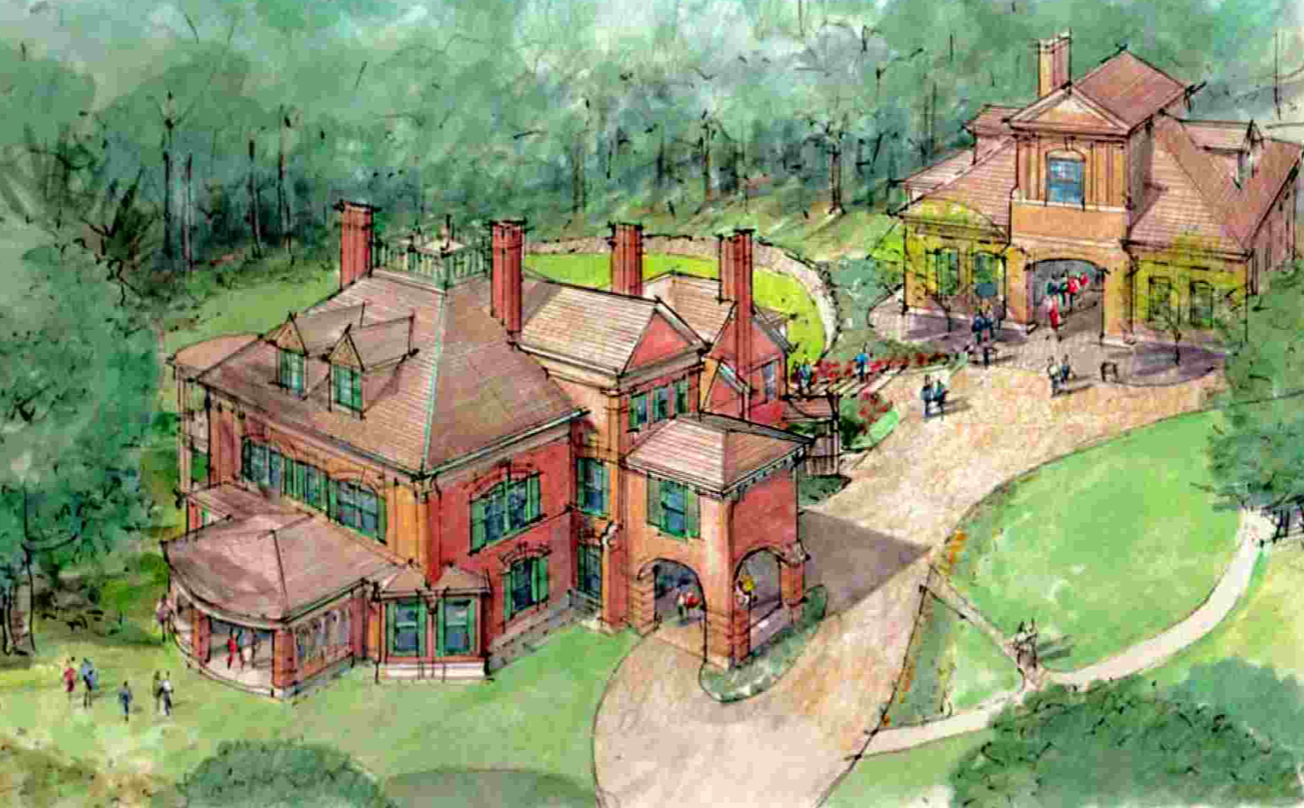
The Brooks Estate represents our history. Fifty acres of woodland and water protect the core of the former summer estates of Peter Chardon Brooks III and Shepherd Brooks. High atop Acorn Hill, the 21-room Manor and Carriage House overlooks the historic landscape. The red brick structures were designed by Peabody and Stearns and erected in 1880. They have been owned by the City since 1947 and are awaiting restoration. The goal is to rehabilitate the buildings to make them income-generating and self-sustaining.
M-BELT is providing the path for the future. For the last twenty-five years, the organization has stabilized and conserved both buildings. They developed a master plan to set a direction for success. The organization is restructuring to turn that dream into a reality. The new President will be responsible for taking charge and moving forward. They will be supported by the Board of Directors, long-time dedicated volunteers, and a planned part-time administrative assistant.
If this sounds exciting, please drop over to their website to learn more, and be sure to send them a letter of interest and resume. https://brooksestate.org/newpresident/
If you missed the wonderful program by Vernon Chandler back on June 1 at the Medford Public Library, you’re in luck! Vern will be presenting his program again at the American Heritage Museum located in Hudson, Massachusetts with more information. This excellent venue is home to some of the best vintage memorabilia of the period. No doubt the program will be even more poignant among period artifacts. The program is December 8, 2023 at 2PM.
The Medford Historical Commission recently was contacted by Vernon Chandler who wanted to share a bit of Medford history with the residents of Medford. He wrote a wonderful little blog post which we are sharing with our audience to raise awareness of our rich and diverse heritage.
Remembering Pvt. Kenneth E. Miller of Medford
My name is Vernon E. Chandler Ill of 34 Prospect St. in Hamilton, MA. My dad (Vernon E. Chandler Jr) and my mom (Joan E. (Gosse) Chandler) were long-time Medford, MA residents, as were their parents Vernon E. Chandler Sr. and Marjorie E. (Morton) Chandler and Charles W. Gosse and Alice (Colby) Gosse. I was born in Medford, MA and lived there with my family until 1957. We then moved to Reading, MA where we lived until I got married in 1977. I then moved to Hamilton, MA where I still live today.
I contacted the Historical Commission because my son (Brian Chandler) and I have been researching my second cousin, Pvt. Kenneth E. Miller of Medford, MA who was killed in Germany in WWII on October 18, 1944. He was the son of John B. Miller and Annie G. Miller (Alice Gosse’s sister) who lived at 19 Liberty Ave. in Medford, MA. We uncovered so much historical information on Kenneth and his unit, the 743rd Tank Battalion and with a lot of research we were able to locate the place the tank-on-tank battle occurred which took his life in Wurselen, Germany. He was only 19 years old. His remains were never recovered and returned home despite the best efforts of his mom, Annie Miller. We are continuing her search through the US Defense POW/MIA Accounting Agency. This agency has classified the search for Kenneth’s remains as an “Active Pursuit”.
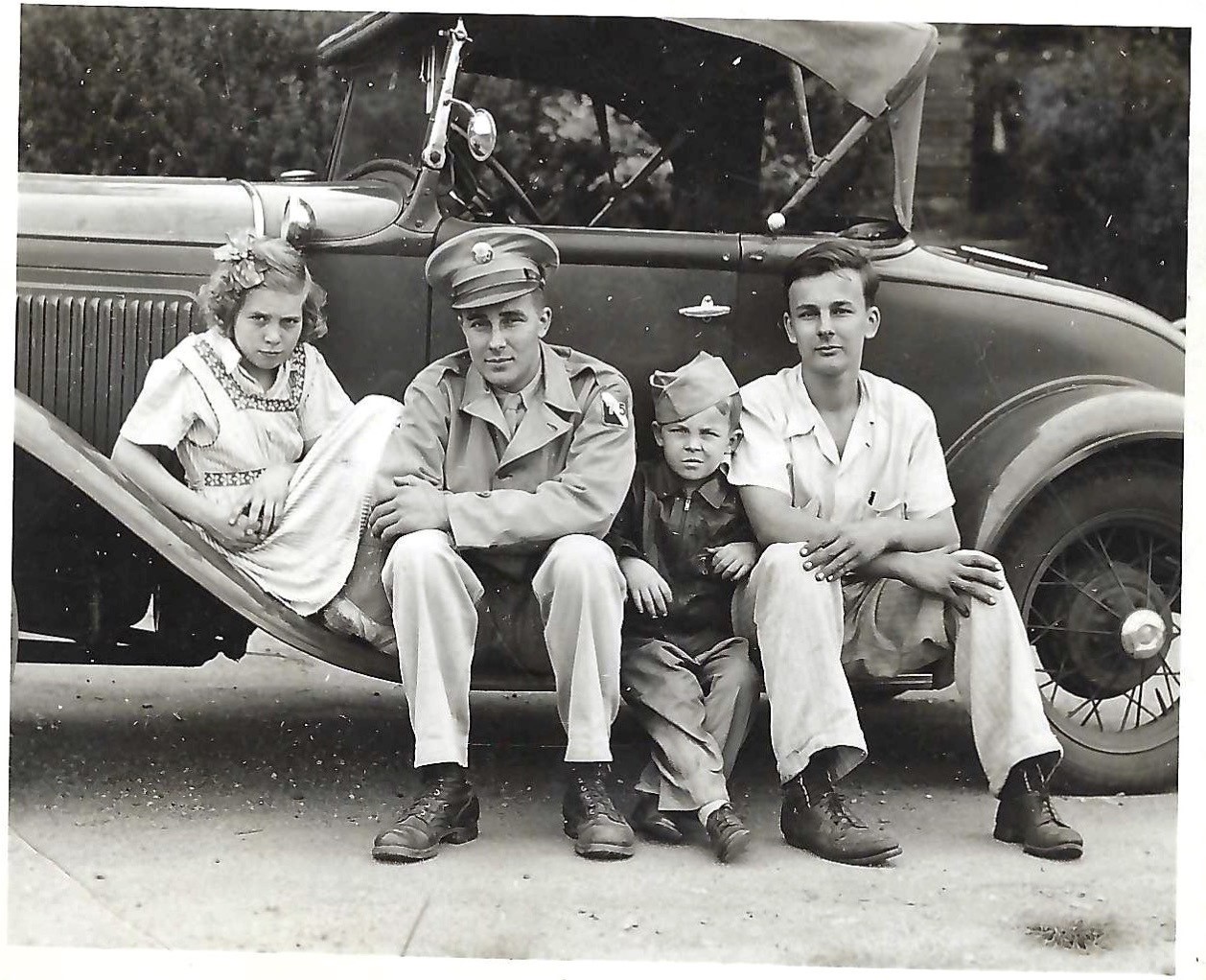
Left to right, my mom (Joan E. Gosse), William Miller, Paul Miller, and Kenneth E. Miller.
My son and I have been so deeply moved by Kenneth’s and his mom Annie’s WWII story, as well as the stories of all who served in World War II, that we planned and took a two-week World War II, 1800-mile driving tour of Europe this past September. Our tour included visits to 6 ABMC cemeteries and many historic WWII sites from Paris, France to Normandy, France to Belgium to The Netherlands to Luxembourg to Germany and finally to Austria. It was an unbelievable experience. We have many pictures and stories we’d like to share with the citizens of Medford, MA. This includes a visit to Pvt. Kenneth E. Miller’s memorial on the Wall of the Missing in Margraten, The Netherlands and, with our German guide, a visit to the actual open corn field location in Wurselen, Germany where the tank-on-tank battle took place and Kenneth’s tank was destroyed and he was killed.
Pvt. Kenneth E. Miller’s name on the Wall of the Missing in Margraten, The Netherlands along with flowers, flags, and his picture all brought by his Dutch adopter and a message we brought to him from all current and former residents of Medford, MA
At Margraten, we met the Dutch adopter of Kenneth’s name on the Wall of the Missing. Yes, Dutch adopter! Most Americans do not know that every grave and every memorial at the Netherlands American Cemetery in Margraten has been adopted and cared for by a Dutch citizen since 1945. They truly appreciate and remember the sacrifices made by their “liberator soldiers” for their freedom. Freedom that they once lost and was then given back to them by American soldiers, kids. To this day they do not forget! They regularly visit and place flowers at the graves/memorials. They even undertook a program called “The Faces of Margraten” where the worked to put a face with every grave and every name on the Wall of the Missing. They even published a book by the same name. Check out the Netherlands American Cemetery online at: https://www.abmc.gov/Netherlands and the Adoption Program on line at: https://www.adoptiegraven–margraten.nl. Click on the flag ofthe USA in the upper right ofthe home page to see the English version of the adoption site.
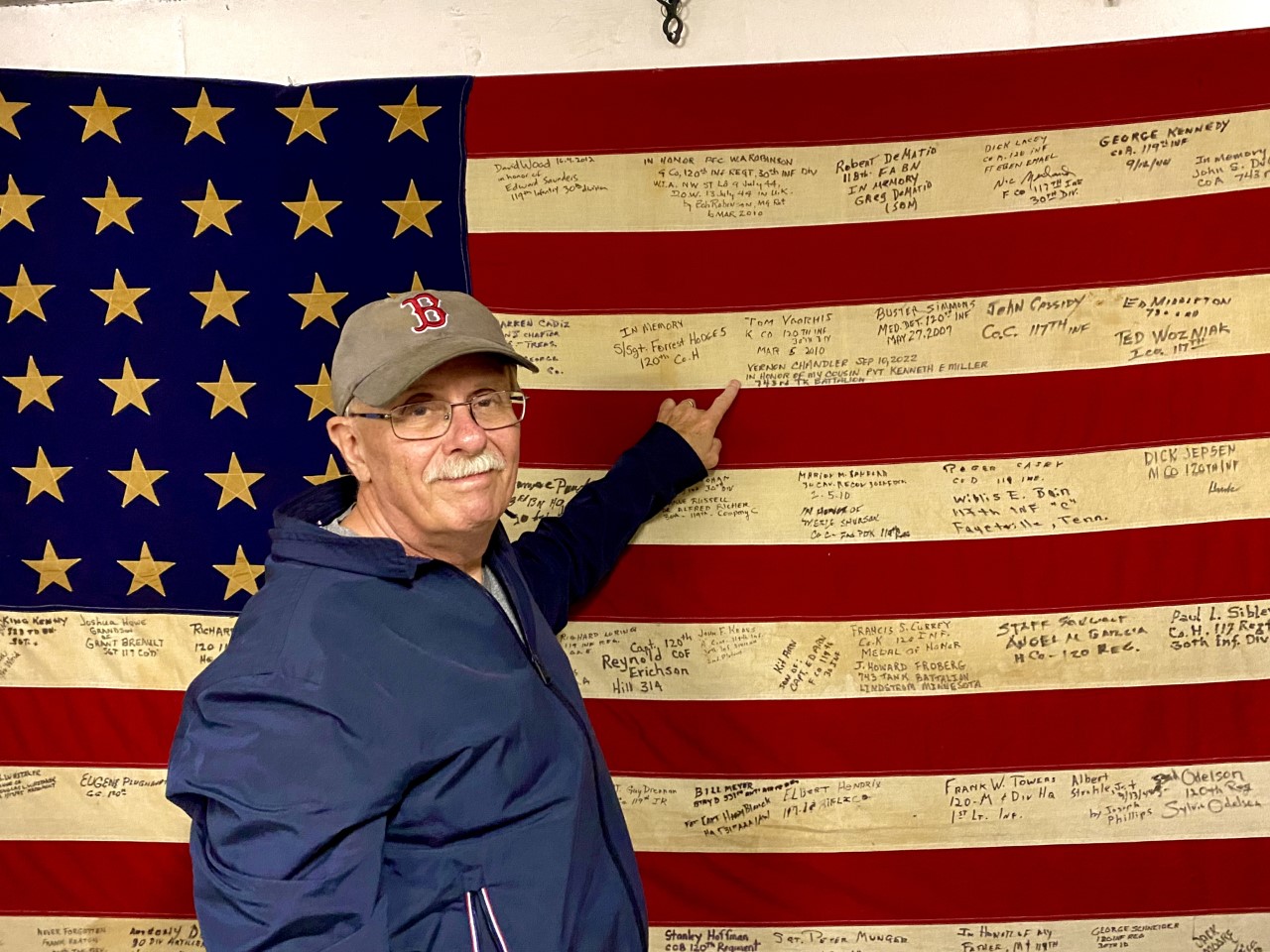
Myself after signing a flag in a Belgian Museum being built to honor the soldiers of the 30th Infantry Division and the attached 743rd Tank Battalion who liberated the town the museum is being built in. I was asked to sign the flag in honor of Pvt. Kenneth E. Miller and I was honored to do so on behalf of the Miller family.
With all of this in mind, I am looking forward to making a multimedia presentation to the Medford Historical Commission, Veterans Association, and interested citizens of Medford, MA to share these experiences with as many as possible and to possibly reach whomever from the Miller family may still live in or near Medford, MA. We believe our once in a lifetime experiences are only meaningful if we share them with others. I am working now to prepare this multimedia presentation to include pictures and video. I plan to make similar presentations in Reading, MA and my current hometown Hamilton, MA in the April timeframe.
Most especially, we want to make sure the words on the sign we put at the Wall of the Missing in Margraten are true, namely: “The people of Medford, MA USA … Know You Are Here!! …
Remember Your Sacrifice!! … And Eternally Thank You!!”
Be sure to be on the lookout for information regarding this presentation very soon!
At our busy December meeting, we voted that the building at 73-75-77 South Street was historically significant. This residence was built – likely as a duplex – circa 1860 and is located on the south bank of the Mystic River, across from Medford Square. Our determination was made based on the age of the house and its association with the South Street resident and shipyard-owner Jotham Stetson.
Stetson Family Ship Building
Stetson’s Medford shipyard was established on this same south bank of the Mystic (near today’s Winthrop Street Bridge) and produced 33 clipper ships that traveled as far as Calcutta, India. Jotham Stetson and his family lived across the street from that shipyard at 102 South Street – a residence that dates to 1822 and still stands today – and he bequeathed to his daughter Almira Stetson the property at 73-75-77 South Street.
Our architectural historians, who have been surveying Medford neighborhood by neighborhood for the past few years, describe this area of the city as “Medford Square South” – the area just south of the River and extending (more or less) to George Street. They describe it this way because it developed early and the homes and businesses that flourished there were part of the life of early Medford; the Cradock Bridge – which connected the two areas – dates back to the early 17th century. But beyond that, the river itself connected the homes and businesses on South Street – like Stetson’s ship yard, and “Grandfather’s House,” the home of shipbuilder Paul Curtis – to life on Medford’s High Street and in Medford Square. Today, we might think of this neighborhood, which has gradually become more residential, as part of South Medford, or Hillside. However, in the first half of the 1800s the Hillside and South Medford were still mostly undeveloped farms and (literally) hillsides, while “Medford Square South” was already bustling with businesses, multi-family residences, and the large homes of prominent residents like the Stetsons.
Form B and other materials from our surveyors, for 73-75-77 South Street are here.
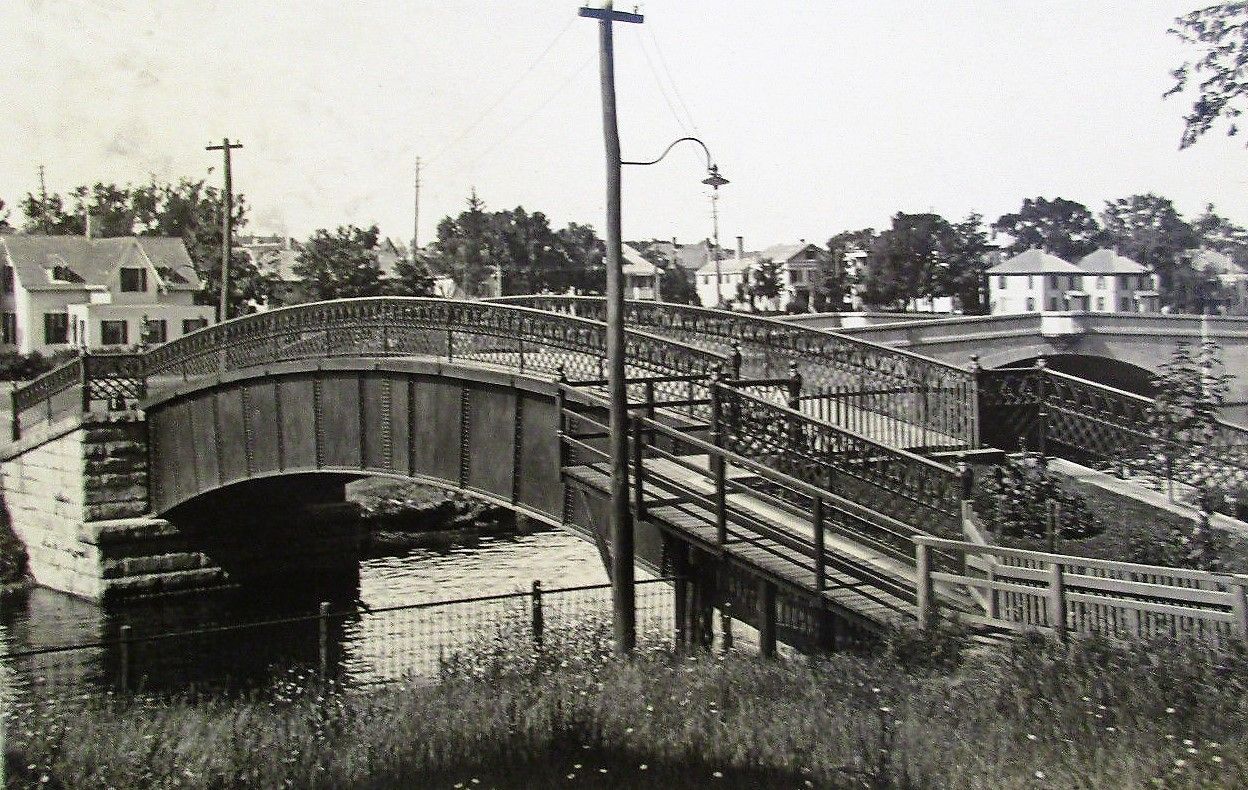
Postcard view looking towards South Street, from the north bank of the Mystic River, circa 1914
At our December meeting, we also voted that the home at 15 Hadley Place was “historically significant.” This vote was based primarily on the home’s size and architectural merits and its association with the building practices and development history of the residential neighborhood surrounding it – the late-Victorian neighborhood that is now “east” of 93.
In the early 20th C the factory buildings of the New England-Anderson Brick Works (which had seen various tenants in the meantime), were taken over by the Worcester Paper Box Company. This company produced paper packaging for a wide range of household products including sugar, tea, coffee, and shoes. Founded in 1914 by Harry Posner, the company had been located in Worcester before its move to Medford. Posner (1881-1962) was born in Mohilev, Russia and emigrated to the United States in 1900, fleeing the pogroms. He first moved to New York, and then to Worcester, where a friend loaned him money to start a company making shoeboxes. After moving his business to Medford in 1927, Posner and his wife Hannah lived at 104 Traincroft Road, off High Street.
Posner was honored in 1938 by President Franklin Roosevelt for his “enlightened labor policy.” Posner’s paper box company helped to finance workers’ homes and their children’s educations, among other employee benefits. In the 1940s, Posner founded Medford’s Combined Jewish Appeal, which he chaired for over two decades. In 1953 Posner made international news with a $1 million donation, earmarked for medical education, to Tufts University, one of the largest donations that university had ever received. He explained then that the gift was “part payment of the blessings we enjoy in this land of freedom an opportunity.” By 1958 his company employed over 300 people at the Medford plant, and later that year Posner bought the buildings of the New England Bedding Company, next door.
The buildings of the New England Bedding Company formerly housed the Glenwood Dye Works, a second turn of the century factory still standing today on the site of the planned 970 Fellsway redevelopment.
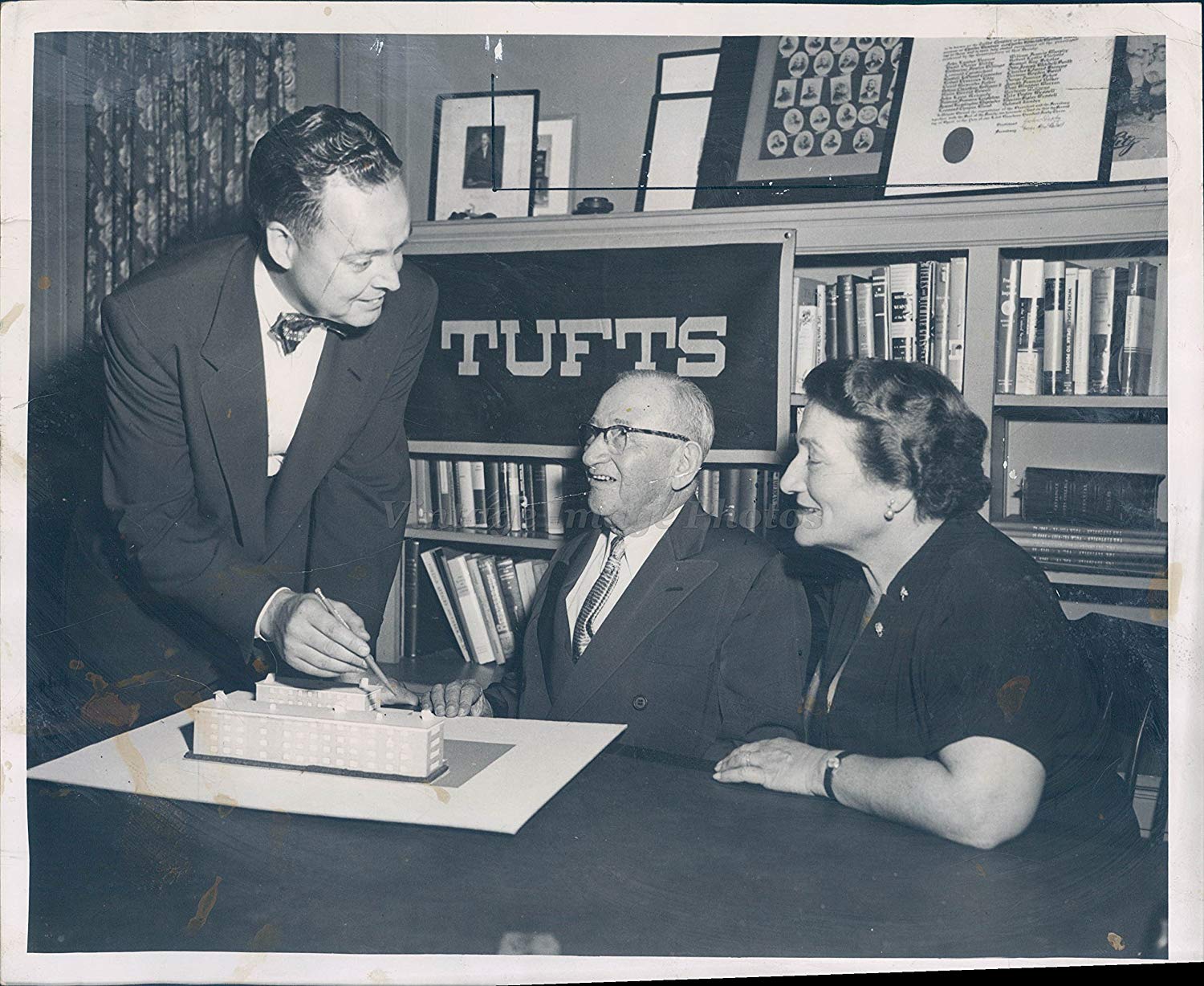
Tufts President Nils Y. Wessell,displays a model for the Posner Hall dormitory at the Tufts Medical School, for Harry and Hannah Posner, c. 1954
The additional 130,000 square feet of the former Glenwood Dye Works allowed the company to remain in Medford during a period of expansion and transition. In March of 1961 Posner’s company was acquired by the Federal Paper Board Company and once merged, Federal Paper Board called the Medford plant one of their “most efficient and well organized units, serving some of our finest and largest customers.” Federal Paper Board, founded in New Jersey in 1916, had aggressively expanded throughout the twentieth century by buying numerous mills and factories. The company was listed on the New York Stock Exchange in 1953 and growth continued apace. The Medford facility was one of several purchased in 1961; in addition Federal Paper Board constructed the world’s largest paperboard mill in Sprague, Connecticut that same year.
The Federal Paper Board Company’s earnings were seriously affected by the 1970s oil embargo. This combined, in 1977, with poor weather conditions and a drop in wood pulp prices. That year the company shuttered two of its carton plants – the Medford, Massachusetts plant and one in Pennsylvania. Around 500 people lost their jobs between the two closures. After Federal Paper Board’s departure, the complex was converted for use by numerous smaller businesses and is still in use today.
The first major industrial building in the Glenwood area was the 1886 construction of the New England-Anderson Pressed Brick Works (970 Fellsway).
That company was founded in 1877 by James C. Anderson of Chicago; the Medford plant was opened in 1886. The company was well known in the 1880s, a period marked by its innovative use of architectural brick work. Anderson credited itself with developing products that were “full of artistic beauty and capabilities” out of a material more commonly associated with plain buildings. Anderson brick was said to have been used on some of the best buildings of the period, including over 100 buildings in New England, and was well known throughout the US and in Europe.
The Medford facility, which employed 75 workers in 1889, was one of three of the Anderson Company – the other two were in Chicago and New York. At their three plants, the Anderson Company produced a total of over 300,000 bricks a day in the 1890s, through a highly mechanized system they developed in-house. Green, unburned bricks were led through a series of tunnel kilns, heated by a perpetual fire fed by crude oil and hot enough to melt steel. The Glenwood facility alone contained eight steam-powered kilns. The quantity of bricks produced in this manner represented a major fuel efficiency over conventional brick production.
The New England-Anderson Pressed Brick Works followed a robust brick-making tradition already established in this part of Medford. Brick production took place here as early as the mid seventeenth century, and it was Medford’s chief business for over a century during the colonial period. By the nineteenth century the Bay State Brick Works, later the New England Brick Works, produced tens of millions of bricks annually at a large plant on the western side of Riverside Avenue.
But the New England-Anderson Brick Works seem to not have occupied the Glenwood buildings long. A newspaper report in 1896 referred to empty buildings in the area. In fact, the vacant factory had attracted the attention of the police, who broke up a major dog-fighting ring in the building in March of that year. The factory’s distinctive architecture, consisting of a large room adjoined by many small windowless kilns, provided numerous hiding places that hampered the police in their effort to pursue the criminals.
Forty-four people were arrested in a raid on the facility and one was shot and fatally wounded while trying to escape. The dogs, still fighting at the time of the raid, could not be separated or subdued and were also killed. All arrested pleaded guilty and were fined between $20 and $25. Two years later the complex was property of the Attleboro Savings Bank.
To be continued . . .
(Most of this history is taken from our surveyor’s Form A for the Glenwood Industrial Area, available here.)
At our October meeting, the buildings at 96-102 Winchester St, near Ball Square, were found to be NOT historically significant and a demo permit was granted.
Photo from the collections of the Wisconsin Historical Society, dated 1961
But the garages at 100 Winchester St were once part of an extensive and long-running commercial dairy operation –
The Whiting Milk Company, active between 1857 and 1973, was one of New England’s first distributors of milk and dairy products door-to-door. It was established by David Whiting (born 1810) in 1857. Whiting’s father, Oliver, owned a large farm in Wilton, New Hampshire. “With the advent of the railroad to Wilton, Mr. Whiting [David] inaugurated operations in the milk contracting business for the Boston market…”
Map from the USDA publication, “The Milk Supply of Boston” 1898
The firm was carried on by his son Harvey Augustus Whiting (1833-1903) and grandsons Isaac Spalding, George, John Kimball, David and Charles Frederick (1875-1972); Charles Frederick used his Harvard (1897) and MIT training to manage the dairy in a modern sanitary manner. Under the direction of David Whiting’s grandsons, the company merged with C. Brigham and Elm Farm Milk (both included in above map) to form a new corporation that, according to the Cambridge Chronicle of 1922, “employs more than 1000 persons and is one of the largest milk distributors in the country.”
In the 1950s, H.P. Hood and Sons and the Whiting Milk Company competed for the majority of the Boston milk market; the photo of the Whiting’s Milk truck at the top of the post is dated 1961. But the business of delivering milk and other dairy product suffered a national decline, due to increased consumer mobility because of automobiles. The company went into bankruptcy in 1973.
Still, most commissioners felt that the history of this company was not reflected in, or represented by the structures on the property at 100 Winchester St. Information above was adapted from the Form B for Winchester St_96-102.
Massachusetts Labor Leaders of the Progressive Era
Part 2 of 2 – On a historical note, the two buildings demolished to make way for the Winthrop St development were once home to two of Boston’s great labor organizers. The first, Mary Kenney O’Sullivan, is now publicly honored in the Massachusetts State House, as part of the State House Women’s Leadership Project. A bronze and marble sculpture, installed at the entrance to Doric Hall in 1995, commemorates the contributions of Sullivan, and other Massachusetts women, to the government of the Commonwealth. Mary Kenney O’Sullivan received this obituary in the Boston Globe on her death in 1943,
[In] Chicago, Mrs. O’Sullivan [worked] with Jane Addams in the Hull House movement for the betterment of conditions in the city’s overcrowded tenement districts. While still in her teens she founded the Jane Clubs for working girls, and was active in putting through the Illinois Legislature laws favorable to working people. She organized the first bookbinders’ union of women in Chicago, was the first woman organizer appointed by the American Federation of Labor, and the first woman factory inspector in the United States.
She came to Boston in 1892 as national organizer of the American Federation of Labor […] After [her husband’s] death in an accident she became an inspector in the Massachusetts Department of Labor and Industries […] holding that position until her retirement in 1934. She founded the Boston Women’s Trade Union League, conducted a camp for working girls at Point Shirley in connection with the Dennison House for many years, and spoke for women’s suffrage. She was president of the Boston Women’s Labor League, vice president of the Boston Women’s Trade Union League, and treasurer of the National Women’s Trade Union League. In 1926 she was appointed a delegate from the United States to the annual conference to prevent war, which was held in Dublin, Ireland, under the auspices of the Women’s International League for Peace and Freedom.
She was a frequent speaker on economics and labor problems at Ford Hall Forum. She was also a member of the Women’s Industrial League and the Massachusetts League of Women Voters. She wrote a number of articles for the Globe on women’s rights, trade unionism and fair labor practices.
The second property demolished, the stone house pictured above, was the home of Philip Davis (1875-1951) and his wife, Belle, both born in Russian Poland, and Jewish immigrants to the US in the late 1890s. According to his Globe obituary, Philip Davis – a friend and colleague of Mary Kenney O’Sullivan’s – was also influential in the settlement house and labor movements of the Progressive Era. While attending the University of Chicago, he too was a protégé of Jane Addams and on her recommendation he attended Harvard, graduating in 1903. He then earned a law degree from Boston University and was active in labor organizing and workers’ rights advocacy in Boston’s North End.






 Medford Historical Commission