History at 541-551 Winthrop St

Massachusetts Labor Leaders of the Progressive Era

winthrop stone house

Part 2 of 2 – On a historical note, the two buildings demolished to make way for the Winthrop St development were once home to two of Boston’s great labor organizers. The first, Mary Kenney O’Sullivan, is now publicly honored in the Massachusetts State House, as part of the State House Women’s Leadership Project. A bronze and marble sculpture, installed at the entrance to Doric Hall in 1995, commemorates the contributions of Sullivan, and other Massachusetts women, to the government of the Commonwealth. Mary Kenney O’Sullivan received this obituary in the Boston Globe on her death in 1943,

[In] Chicago, Mrs. O’Sullivan [worked] with Jane Addams in the Hull House movement for the betterment of conditions in the city’s overcrowded tenement districts. While still in her teens she founded the Jane Clubs for working girls, and was active in putting through the Illinois Legislature laws favorable to working people. She organized the first bookbinders’ union of women in Chicago, was the first woman organizer appointed by the American Federation of Labor, and the first woman factory inspector in the United States. osullivan

She came to Boston in 1892 as national organizer of the American Federation of Labor […]  After [her husband’s] death in an accident she became an inspector in the Massachusetts Department of Labor and Industries […] holding that position until her retirement in 1934.  She founded the Boston Women’s Trade Union League, conducted a camp for working girls at Point Shirley in connection with the Dennison House for many years, and spoke for women’s suffrage.  She was president of the Boston Women’s Labor League, vice president of the Boston Women’s Trade Union League, and treasurer of the National Women’s Trade Union League. In 1926 she was appointed a delegate from the United States to the annual conference to prevent war, which was held in Dublin, Ireland, under the auspices of the Women’s International League for Peace and Freedom.

She was a frequent speaker on economics and labor problems at Ford Hall Forum. She was also a member of the Women’s Industrial League and the Massachusetts League of Women Voters.  She wrote a number of articles for the Globe on women’s rights, trade unionism and fair labor practices.

More information about Mary Kenney O’Sullivan’s life and work can be found on the website for the State House Women’s Leadership Project.

state house2The second property demolished, the stone house pictured above, was the home of Philip Davis (1875-1951) and his wife, Belle, both born in Russian Poland, and Jewish immigrants to the US in the late 1890s. According to his Globe obituary, Philip Davis – a friend and colleague of Mary Kenney O’Sullivan’s – was also influential in the settlement house and labor movements of the Progressive Era. While attending the University of Chicago, he too was a protégé of Jane Addams and on her recommendation he attended Harvard, graduating in 1903. He then earned a law degree from Boston University and was active in labor organizing and workers’ rights advocacy in Boston’s North End.
Demo Application: 45-47 Mystic Ave

[At the April 2019 meeting of the Medford HC, this property was found to be NOT historically significant, and the demo permit was granted.]

The Medford Historical Commission has received an application to demolish the *house and* carriage house at 45-47 Mystic Ave. A Massachusetts Historical Commission Form B was recently prepared to detail the history of the property, including the carriage house building.

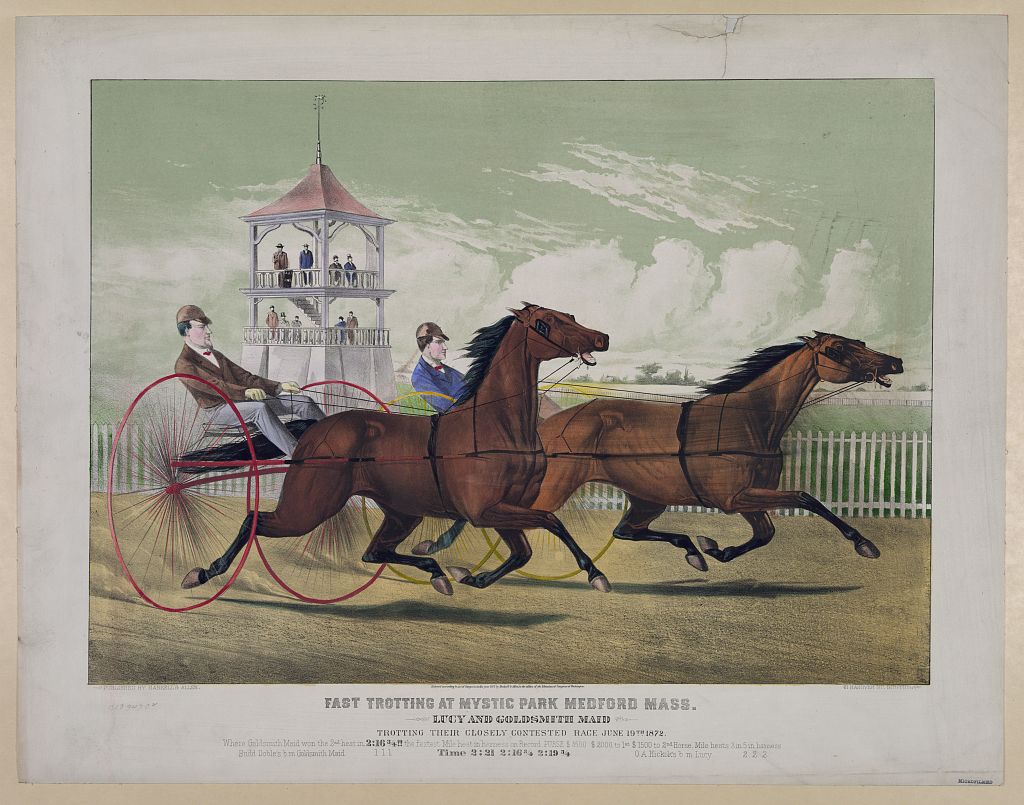
Horse Racing & the Medford Mustang

For a peek at the life of “Honest” James Golden, a famous horse trainer at the Mystic Trotting Park and beyond, check out the Form B.

Trotting

Image of the 1872 race of Lucy and Goldsmith Maid,  from the Library of Congress

The Commission will post additional information to this page as review of this demolition proceeds.

MysticAve_45-47 MassHC Form B

[Updated April 11 – At our April meeting, the application for demolition of the house and garage at 45-47 Mystic Ave was approved, as these were NOT found to be historically significant.]

March Determinations

At our March meeting, the Commission made the following determinations:

Finding so many properties on our agenda historically significant is quite unusual for our commission, but each of these properties represents an interesting aspect of Medford’s history. Together, they make a fascinating timeline of past life and work in Medford.

Shipbuilders on Foster Court

The small Cape Cod on Foster Court was built between 1804 and 1814, making it one of Medford’s earliest surviving examples of the architectural form for which New England is famous. The Cutter House was owned and occupied by Rebecca Cutter, the widow of a soldier in the Revolutionary War, who supported herself after his death by taking in boarders in the small cottage. Her descendents, who later inherited the house, were part of the Medford shipbuilding families of Sprague and Foster.

The stately Italianate Seaver House on Winchester St is one of the earliest remaining buildings in Ball Square, a commercial and residential neighborhood which developed around the old “Willow Bridge” station of the Boston & Lowell Railroad line. The house (ca. 1865) still has much of its beautiful exterior detail and decoration.

7 Lauriat Place (ca. 1890), in Washington Square, was one of several gold-beating workshops owned and operated by the Lauriat family – a family of scientific innovators and experimenters who settled in Medford in the 19th century. They employed highly-skilled men and women in gold-beating – creating paper-thin gold leaf.  The building itself is “an exceptionally rare survival of a small workshop for producing machine- and hand-worked artisanal goods.” Similar workshops “were once a common feature of the built environment of New England” but “have largely disappeared” and with them the history of this skilled labor as well. Quotes taken from the Lauriat Pl_7 Form B prepared by our architectural historians. 

Cincotti Funeral Home on High St has been a community landmark where West Medford families have honored their loved ones throughout the 20th century.

Each of these buildings will have a public hearing at our April 8 meeting, to determine if it is preferably preserved.

If a building is found preferably preserved, an 18 month delay of demolition will take place, to give the owner time to consider renovation, reuse, relocation and other alternatives to demolition.

Demo Application: 7 Lauriat Place

The Medford Historical Commission has received an application for the demolition of the building at 7 Lauriat Place located within the Washington Square neighborhood of East Medford.

Early Innovators! Gold Leaf & Hot Air Ballooning

The building at 7 Lauriat Place was a large “gold-beating,” or gold leaf, workshop run by the Lauriat family. Louis Anselm Lauriat was an innovator of the gold leaf craft in Boston in the early 1800s; he also pursued chemical experimentation, and hydrogen aerial ballooning in cities and towns throughout New England, and as far away as Milwaukee, WI and Memphis, TN! His family moved to Medford and established a number of successful gold leaf workshops here – on Ashland St and Riverside Ave (both c. 1880) where they employed more than 40 men and women in the highly skilled technical labor. The last of the Lauriat gold leaf workshops was built on 4 Lauriat Place, in the late 1890s, with a Lauriat family residence next door at 5 Lauriat Place. Medford’s Lauriat Gold Leaf Workshop, at 7 Lauriat Place, continued the craft for another 30 years until the workshop became a printing business. 

gold beating

Image from the pamphlet “The History of Gold Leaf and its Uses” published by the Boston Gold Leaf manufacturer F.W. Rauskalb, in 1915.

Medford’s Lauriat Gold Leaf Workshop has already been recommended for inclusion in the National Register of Historic Buildings by our architectural historians. The Commission will post updates below during the review process.

7 Lauriat Place MHC Form B
Washington Square Area Form
Click here for the neighborhood overview for East Medford

Legal Advertisement for 7 Lauriat Place
Determination of Significance for City Clerk

Demo Application: 67 Magoun

IMG_1412.JPG

The Medford Historical Commission accepted the application for the demolition of the carriage house and barn at 67 Magoun Avenue. The building, and its associated dwelling house, were once “the Medford Hospital,” a private institution that began in the early twentieth century. The c. 1895 Queen Anne buildings are located within the East Medford neighborhood. They were identified as part of a grant from the Massachusetts Historical Commission in 2014.

More info on the property in our Form B.

The building has been determined significant by the Commission. A letter to the clerk has been submitted and can be found here: Clerk’s Letter – 67 Magoun. The legal posting for the meeting can be found here: Legal Posting – 67 Magoun.

Women in Medicine

Dee Morris wrote an excellent article about Abby Rollins, the doctor who operated the Medford Hospital, for the Medford Transcript. The article can be found online or by viewing the PDF file here: Homeopathy and Medford by Dee Morris

[Updated January 2019 – the Commission unanimously voted the building preferably preserved and enacted an 18 month demolition delay, to consider renovation, reuse, relocation and other alternatives to demolition.]